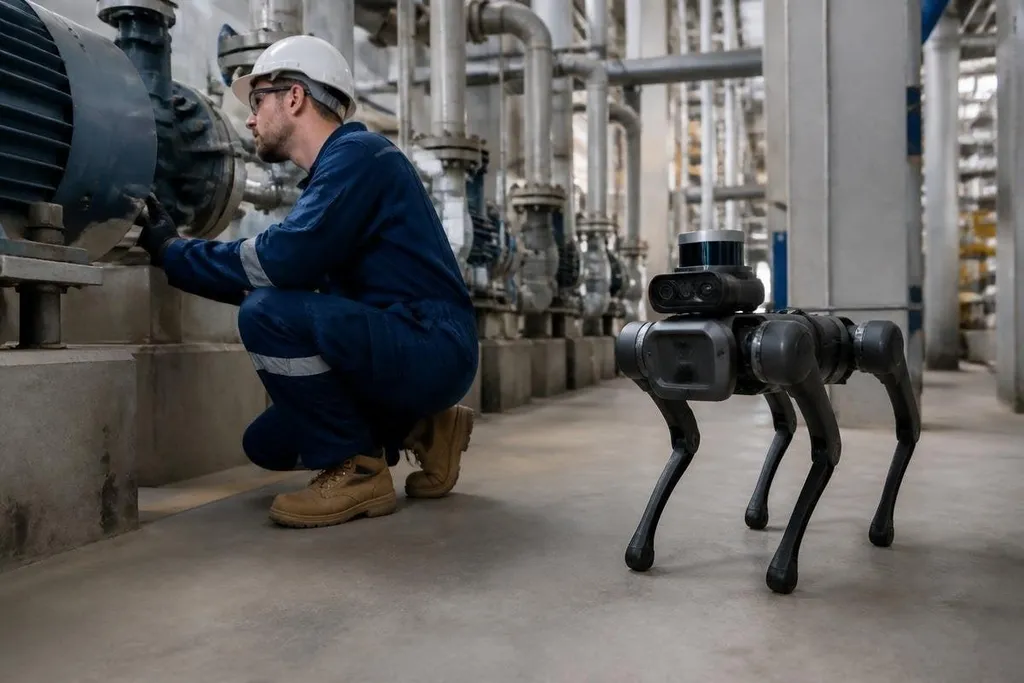
Maintenance robots are moving toward a practical job: checking equipment, carrying tools, and handling work in places that are unsafe or hard to reach. The useful question is not whether a robot can move through a site, but whether it can find a fault and help fix it without slowing the technician down.
- Inspection robots can use cameras, thermal sensors, microphones, or LiDAR to check equipment.
- Mobile platforms can carry tools and sensors through large sites.
- Repairs still need human judgment when the fault is unclear or the work affects safety.
Inspection comes before repair
Many maintenance tasks start with information. A technician needs to know what has changed, where the problem sits, and how fast it may get worse. A robot can repeat the same inspection route and record images or sensor readings from the same position each time.
That repeatability matters because small changes are easier to spot when each inspection follows a similar path. A camera may show a loose part. A thermal sensor may show a hot bearing. An acoustic sensor may pick up a sound that does not match normal operation.
The robot still needs a clear task. “Check the machine” is too broad. “Scan this pump, compare the bearing temperature with the last visit, and flag a change” gives the system a job that a technician can review.
Moving through working sites
A maintenance robot may need to travel across concrete floors, ramps, stairs, gravel, or narrow service areas. Wheels work well on smooth floors. Tracks can help on rough ground. Legs can step over gaps, but they bring more motors, software, and points that need service.
The site itself can change during a shift. Doors may close, pallets may move, and people may cross the robot’s route. Sensors help the robot detect these changes, but detection does not remove the need for safe operating rules and a person who can stop the machine.
Robot arms add another task. The robot may carry a camera to a panel, hold a light, or position a tool.
Holding a tool is easier than using it correctly. The arm must apply the right force, reach the right part, and respond when a bolt or cover does not move as expected.
The repair gap
Inspection has a clearer path to use than repair. A robot can collect evidence without changing the equipment. Repair work can damage a part if the robot applies too much force, uses the wrong tool, or acts on a poor fault diagnosis.
That gap means many maintenance systems will start with remote control. A technician can guide the robot through a difficult area, position the arm, and check the live camera view. The robot handles movement and carries the sensor, while the person makes the call.
Over time, software may take on repeatable actions such as opening a known panel or placing a sensor at a fixed point. Each task still needs a clear limit, a stop command, and a way to record what happened. Nobody has shown that a general repair robot can handle the full range of faults found in a working plant.
Maintenance buyers need more than a robot that reaches a panel in a demo. A report from Robot24 can help you compare the machine’s task, test site, fault record, and result before you set a budget. Those details lead into the checks before buying.
What to check before buying
A maintenance robot should earn its place through the work it removes or improves. Use this checklist before a pilot:
- Name the task: Write the inspection or repair step in plain language.
- Check the site: Map floors, ramps, stairs, doors, lighting, and worker traffic.
- Measure the handoff: Decide how the robot sends images, readings, and fault alerts to a technician.
- Set the stop rules: Define when a person takes control or ends the task.
- Price the full setup: Include sensors, software, training, service, spare parts, and site changes.
- Test the failure case: Run the task with blocked routes, poor lighting, missing parts, and a false alarm.
The hardest part may be the handoff between a robot’s finding and a person’s decision. A system that cuts inspection time but sends unclear alerts can add work instead of removing it.
I'd start with repeatable inspection in a known area, then add remote control and tool handling after the records show that the first task works. The next useful proof will be a maintenance robot completing a defined repair on a real site, with its mistakes and human interventions recorded.